CPS4 is an atmosphere/ocean/land/sea ice-coupled prediction system consisting of an initialization system and a forecast model. Its atmosphere-land surface model is largely based on that of CPS3, which is an enhanced version of JMA-GSM2003 (Yonehara et al. 2020, JMA 2022) for seasonal prediction.
CPS4 features refined cloud, stratocumulus and cumulus convection schemes, land-snow and lake models, and other elements.
Prognostic ozone with linear ozone photochemistry parametrization is used in the radiation process instead of the monthly climatology derived from MRI-CCM2 reanalysis (Deushi and Shibata 2011) used in CPS3, resulting in enhanced representation of stratospheric circulation.
Atmospheric conditions are initialized with JRA-3Q (Kosaka et al. 2024) for re-forecasts, and Global Analysis (GA) for operation, in which atmospheric conditions are updated with a shorter delay.
CPS4 has a different land-sea mask from these analyses and a unique lake scheme (Adachi et al. 2025) requiring initialization.
To avoid initial shock, offline surface simulation for the period to date is separately run and used for forecasts.
Ozone concentration is initialized with ozone analysis generated by MRI-CCM2.1 (Deushi and Shibata 2011, Yukimoto et al. 2019) as with JRA-3Q for use in the initialization of a linear ozone scheme.
Ocean and sea ice conditions are initialized with MOVE/MRI.COM-G3 (Fujii et al. 2023) "a global ocean 4DVAR analysis (Usui et al. 2015) downscaled to an eddy-permitting resolution (0.25 by 0.25° in longitude and latitude)".
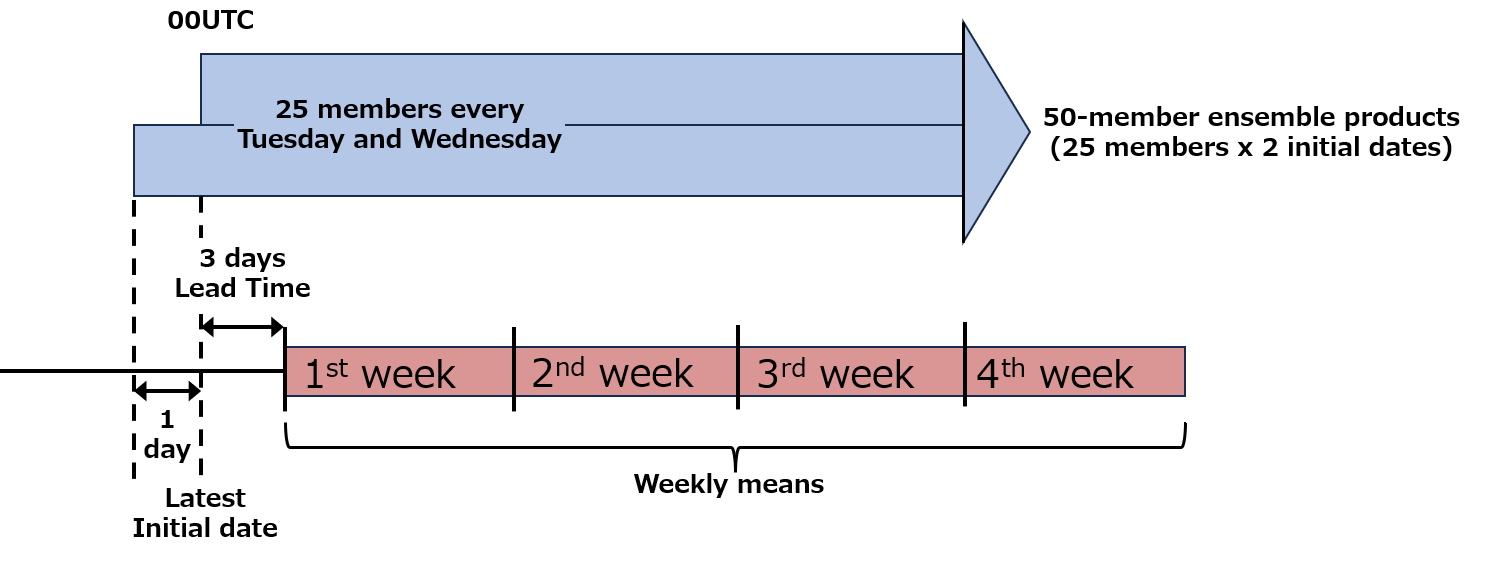
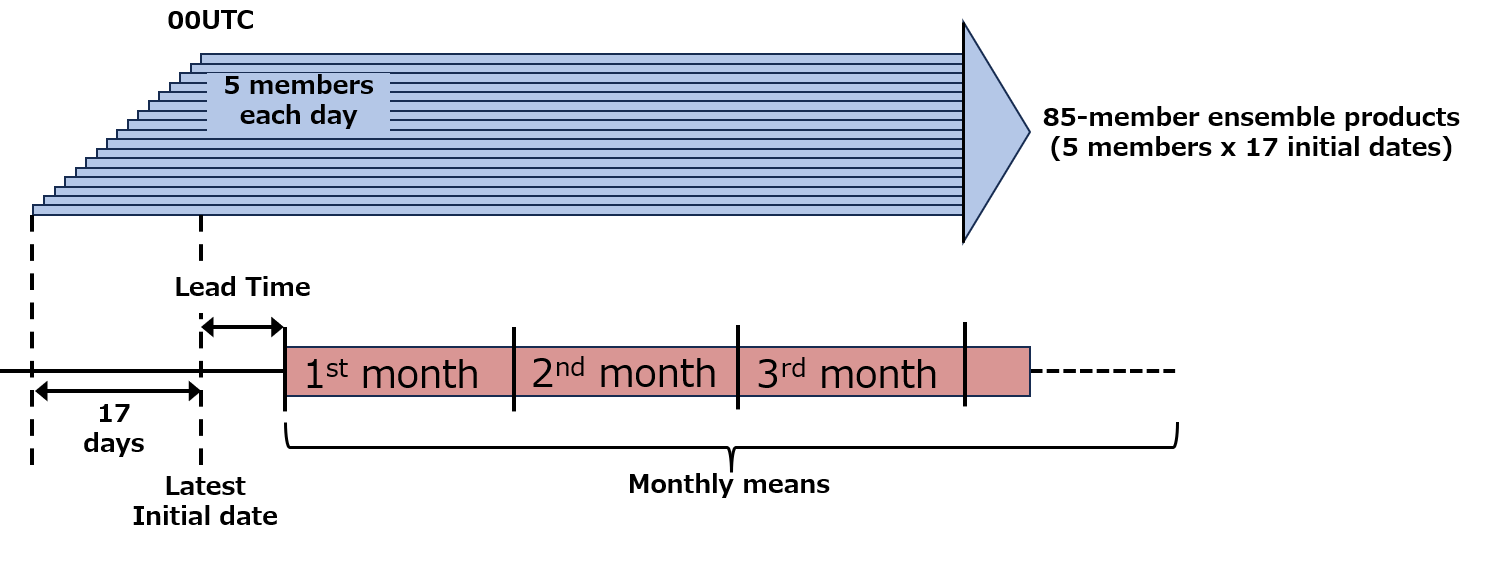
The ensemble prediction system involves a combination of LAF, initial and model perturbation.
Perturbed atmospheric conditions are determined for each initial time using SV+LETKF.
Ocean perturbations are calculated using 4DVAR minimization history, by which daily analysis error covariance can be approximated (Niwa and Fujii 2020).
| System Name |
JMA/MRI-CPS3 (Hirahara et al. 2023) |
JMA/MRI-CPS4 (Kubo et al. 2025) |
| Operation Start Date |
February 2022 |
January 2026 |
| Atmospheric model |
Model version |
GSM2003C |
GSM2003C* |
| Horizontal Resolution |
Global TL319 reduced Gaussian grid(~55km) |
| Vertical levels(model top) |
100 levels(0.01hPa) |
128 levels(0.01hPa) |
| Ocean model |
Model version |
MRI.COM v4.6 (Tsujino et al. 2020) |
MRI.COM v5.0 (Sakamoto et al. 2023) |
| Horizontal Resolution |
0.25° (longitude) x 0.25° (latitude) |
| Vertical levels |
60 levels |
| Forecast Frequency |
5 ensemble members per day |
25 ensemble members up to 1-month every Tuesday and Wednesday
5 ensemble members per day |
| Initial condition |
Atmosphere |
JRA-3Q (hindcasts) and the Global Analysis (GA; forecasts only) |
JRA-3Q (hindcasts), GA (forecasts only) and Ozon Analysis |
| Land Surface |
Offline model runs forced by JRA-3Q and GA (forecasts only) |
| Ocean |
MOVE/MRI.COM-G3(Low-res. 4DVAR+High-res. downscaling) |
| Sea ice |
MOVE/MRI.COM-G3(3DVAR) |
| Ensemble generation method |
Initial Condition perturbation |
The breeding of growing mode (BGM) method for the atmosphere
Ocean perturbations calculated using 4DVAR minimization history
The Lagged Average Forecast (LAF) method |
The Singular Vectors (SVs) and Local Ensemble Transform Kalman Filter (LETKF) methods for the atmosphere
Ocean perturbations calculated using 4DVAR minimization history
The LAF method |
| Model Perturbation |
Stochastic Perturbation of Physics Tendency (SPPT) for the atmosphere |
SPPT and Stochastic Humidity Profile for Convective parametrization (SHPC; Ota 2025) for the atmosphere |
| Hindcast |
Period |
Two initial dates per month for 1991-2020 |
| Ensemble size |
5 members / day for 6-month prediction |
13 members / day for 1-month prediction
5 members / day for 6-month prediction |